
On the Old Castle Road the village smithy stands, although the walls seem ready to collapse. Adjoining this ancient building and reached by an outside stair was the Dog Infirmary. Mr Robert Peddie was at one time the vet, and blacksmith, and his thatched cottage stood alongside until 1892 when a tenement "Rosebank Terrace" was built on the site.
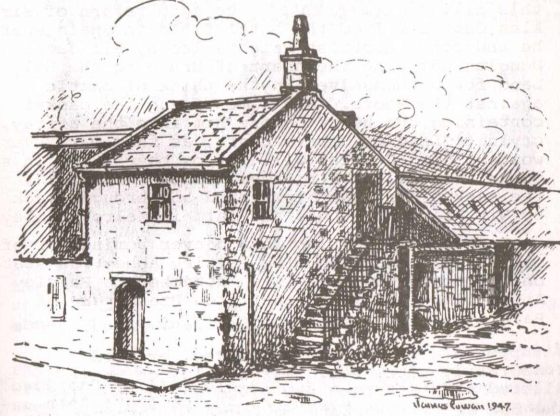 "Rosebank Cottage", on the opposite side of the road until recently, belonged to this family of vets and smiths. Miss Roberta Peddie (Mrs J.S. Tait) is the last representative of a family who have lived in Cathcart for hundreds of years. Originally armourers and smiths to the Cathcart Family, one, branch through time became known as the 'Farmers' Peddie and the other as the 'Smiths'. When Carmunnock Road and Manse Brae were but winding country roads, Cathcart Mains Farms was beside the old manse. Castle Mains Farm was also known as "Peddie's" although Mr Robert Ure had taken over the farm for forty years. He died in 1958 and privately-owned houses, now cover the area.
It is said that Robert Burns had his horse's shoe repaired at the smithy. The vet. remembered by most today would be Mr A.S. MCQueen, M.R.C.V.S., who lived nearby and who died in 1938. The Dog Infirmary building has since been used by a series of small firms in no way connected with dogs.
 Across the way was once a "wee bit biggin'", later to become the Cathcart Rifle Range. The village well stood at this point but all have disappeared. Prefabricated homes, erected temporarily after World War II, lasted their allotted time and have now given way along with the row of mill workers cottages to Corporation-built dwellings.
Changes have also taken place along Rhannan Road. HOlmhead House once belonged to the Hamiltons. Dominie Carnduff had Cliff House built 'on one corner of Craig Road, Wilson's shop being on the other. Gone now is the row of cottages at the top of the hill.
In 1932 Edith Cottage was opened by Mrs Fred. Shoe smith and named after her. It is the happy haunt of Cathcart's old men but, with attitudes to age forever changing, the occupants today surprise us with their freshness and vigour. It is a far cry from the bearded and bent figures who at one time would have frequented here.
Ex-councillor Shoesmith was also the river bailie and chairman of the Fairy Dye Company. He lived in nearby "Hawthorn Lodge" and, through his generosity, the Old Men's Club pavilion was built. Previously on this ground was John Macindoe's steadinq "Kilmailing", and prior to 1875 there stood a row of weavers' thatch-roofed cottages.
Continuing in reflective mood, from about 1880 the first Post Office in Cathcart was part of a grocer's shop - Mr John MCGaw's of Greenbank Place - now 104 Old Castle Road and still a grocer's. A sub-office, part of a house in the "Shank" (so named because it led to the shaft of the old coal pit in Dairsy Street) was recently demolished. So too was Prosser's old shop building which was over 100 years old, though, happily, members of this family continue in business only a few yards away.
Cathcart sub-office moved to various shops in Adelaide Place, Mary Place, and Queen's Crescent, the lettering of these place names still faintly visible. On September 1st, 19l6,the Post Office proper was opened in Rhannan Road.
Today the postie's unfamiliar grey uniform replaces the friendly navy and red. Rather than wait on the postman calling, firm's messengers used to stand at given pOints to collect the mail. A charge was made for deliveries at one time - and again we hope this form of tax is forgotten for all time.